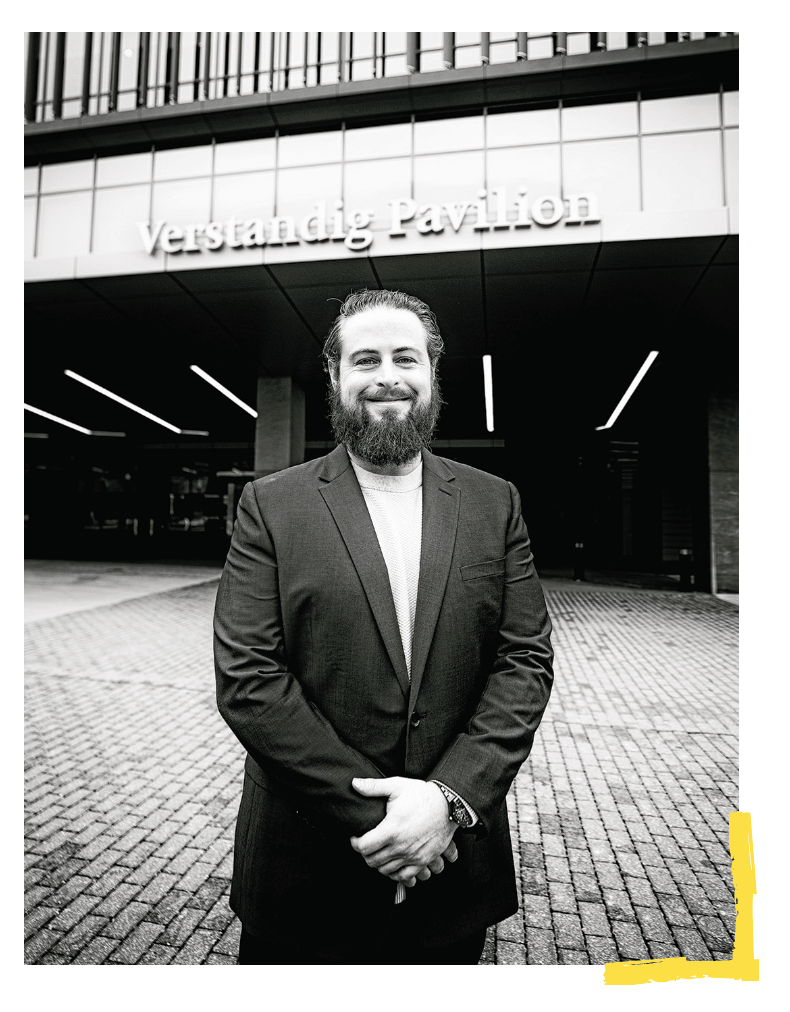
Washington, DC – April 23, 2026 – At just 28, Grant Verstandig achieved the type of success many entrepreneurs could only imagine, selling his digital health care startup, Rally Health, to UnitedHealth Group Inc. for $4 billion.
He could’ve easily stepped back from the all-consuming life of an entrepreneur to focus on philanthropy and consulting. He could’ve made a career at UnitedHealth, where he briefly worked as chief digital officer, following the all-stock sale that closed on Valentine’s Day in 2017. He could’ve returned to college to finish his degree — as his parents wanted — after dropping out of Brown University to launch what would become Rally Health.
But he was too restless, firm in his belief that technology has the potential to solve society’s problems and compelled by a grand ambition to make the world a better place.
So in 2020, he started McLean investment and incubation engine Red Cell Partners LLC to build, fund and grow companies in areas that he believes are most in need of reinvention: health care and national security.
Red Cell has since incubated or backed 20 companies, which have collectively raised hundreds of millions of dollars. It’s also assembled a team of advisers and investors that reads like the board of directors at a Fortune 500 company. Think former Federal Reserve Vice Chairman Roger Ferguson, Yahoo Inc. founder Jerry Yang and former Northrop Grumman Corp. CEO Wes Bush.
The inefficiencies Verstandig sees in health care were born out of personal experience: In the last 14 years, Verstandig has endured more than 20 surgeries on the knee he blew out playing high school football, cutting short a promising college lacrosse career. The national security focus stems from his upbringing as a child of federal workers and the belief that, in the age of artificial intelligence, the threats to the country and its critical infrastructure are greater than ever.
It’s fair to wonder why Verstandig, already fabulously wealthy at just 37, would want to work more than 100 hours a week at Red Cell and its affiliates while raising a family — he and his wife have two young kids — and sitting on boards of numerous organizations, including his own family foundation.
After all, what Verstandig achieved with Rally Health was hard to do once and often tougher to replicate, says Ted Leonsis, a partner at Revolution Growth, which in 2024 invested in Red Cell’s Zephyr AI Inc.
“There’s a lot of people who have a first big win, and then they check out,” says Leonsis, also the CEO at Monumental Sports & Entertainment. “They don’t say they’ve retired, but they’ve gotten off the train.”
Verstanding, though, has a chance to join an elite club of “successful serial entrepreneurs” who build and sell multiple companies, Leonsis says. “I’m betting — I think a lot of people are betting — that he’ll be one of the people that breaks out.”
But for Verstandig, big exits are beside the point. Yes, he’s set goals for Red Cell — $100 million in revenue across its portfolio this year, standing up one or two new companies a year — but “the sense of urgency that I have is in part because these systems are in crisis,” Verstandig says.
“I don’t really feel like, ‘Oh, I’ve accomplished so much.’” he says. “I’m just getting started.”
Vantive Technology evolves from Red Cell
Verstandig sits at a table in his office, a cup of Expo markers atop its dry-erase surface, so no idea goes forgotten.
He pops out of his chair when asked about the wall-sized whiteboard that’s already marked up, his handwriting engulfing the board in phrases and arrows and circles, color-coded in red, green, orange, blue, black.
To an outsider, it’s chaos. To him, it’s crystal clear. He explains a small section, how the pieces connect, and that if it’s erased, it’s OK; he’s taken a mental snapshot.
Spend an afternoon with Verstandig, and you’ll pick up on some quirks. His fondness of most fruit-infused Hint water varieties (except strawberry kiwi) stocked in Red Cell’s refrigerators. That he’s a self-described sneaker enthusiast and picked a pair of Nike ZoomX shoes for today that squeak when he charges out of a meeting to take a call. You’ll learn that the chair to his right is already taken for his leg, and that it’s unusual these days for him to be without crutches.
And you’ll see how his entrepreneurship journey — through building Rally, then defense-tech startup Epirus Inc., which makes power management and counter electronics products for the battlefield — informed what Red Cell is all about.
Red Cell aims to better support other founders by handling the work that detracts from their missions. It plugs in its own executives — seasoned experts they wouldn’t be able to hire on their own — across those companies’ finance and accounting, legal, operations, marketing, human resources and other functions. That way, Verstandig says, they “don’t start at the 1-yard line” and can focus on what they do best.
The operating-company approach provides “the business-function backbone,” says Brennan Grignon, former director of industry outreach and supply chain resilience at the Department of Defense, and co-founder and CEO of supply chain startup Vantive Technology Inc., which launched out of Red Cell earlier this year. “Running a business is a small portion of my time; the preponderance of my time is building a technology solution and driving market.”
Vantive came out of Red Cell’s evolution. The firm was exploring technology for supply chain analytics, and Grignon thought she could build it.
She soon briefed a handful of Red Cell executives on her market research, Verstandig taking notes and highlighting things as she spoke. She later secured pre-seed funding and a green light to take it forward. The result: tech to help organizations prepare for supply chain risks before crises like the Covid pandemic upend their businesses.
Red Cell also has companies like Hunted Labs Inc., an AI platform to protect from cyber threats in open-source software, not born within Red Cell, but taken in after it struggled to raise capital. Now it’s coming back to market with a crucial contract in hand.
To date, Red Cell has incubated 15 companies, 12 of which operate today, and invested in five others, in areas ranging from population health and drug discovery to logistics and cybersecurity. Verstandig is CEO or executive chairman at six, while leading Red Cell itself. The enterprise comprises 374 people, including 75 at Red Cell and the rest within those ventures, mostly in early stages averaging 15 months old.
Red Cell has hit some bumps. It founded Eyris, its first cyber business, in 2023, but shut it down by December 2024 because the timing was wrong, says Katie Griff, Red Cell’s chief marketing and communications officer, and Verstandig’s friend of more than 15 years. Another incubation, LightBox, built to support health care providers in billing and insurance operations, has since been wrapped into Trase Systems Inc., a newer Red Cell company with an AI tool to help organizations improve their workflows — and whose approach was complementary to LightBox’s business.
“You have to continue to reselect and reinvest in your winners because there’s not infinite capital; these companies have real burn,” Griff says.
One of Red Cell’s newer companies, Crux Inc., launched out of stealth mode in March with $6.5 million for its employee benefits program to make prescriptions often not covered by insurance more affordable. To do it, Verstandig got his old band back together: Crux’s co-founders — Chip Nash, its CEO, and Naimish Patel, Red Cell’s chief growth officer — are both Rally alums.
Crux has started making GLP-1 medications available directly to patients through deals with pharma giants such as Eli Lilly. It intends to expand into other cardiometabolic drugs and, by year’s end, oncology products. That would be “Version Awesome” — a term Verstandig uses often as a product engineering guy.
Red Cell’s secret sauce lies in its companies working together, something that’s been happening more in recent months, Verstandig says. Exhibit A: Trase assisted Crux in building its product in about six months. Compare that to Rally’s flagship product, which took hundreds of millions of dollars and about six years.
It’s the perfect moment for such collaborations, he says, because agentic AI can do things that software never could, saving substantial time and money.
Last year was Red Cell’s best yet as measured by growth in assets under management and headcount — requiring it to move into another floor of the building at 1800 Tysons Blvd.
“All the things that I had a vision for,” Verstandig says, “we’ve now either built, attempted, created, or we’ve done it.”
Red Cell’s who’s who of advisers, investors
Verstandig constructed Red Cell with some of the biggest names in Greater Washington business as executives, partners, board members, mentors and investors.
The list includes Bush, the former Northrop Grumman chair and CEO; Roger Ferguson Jr., former CEO of retirement services firm TIAA and onetime vice chairman of the Federal Reserve Board; Kenneth Samet, the CEO of MedStar Health; and many others.
Some had known Verstandig from the Rally days. Others saw what he’d done there and wanted in. All marvel at his intelligence, passion, curiosity, big ideas — and desire to effect change.
“What he’s done with his life very much came from that same teenage boy that was interested in and curious about health care … from the standpoint of, ‘How do I participate? How do I make a difference? How do I make change?’” says Samet, whose daughter attended high school with Verstandig.
Verstandig puts it more succinctly: “You can do really well by doing good.”
To some, it may sound like a talking point. But Verstandig watched his father, Lee, a Republican, work in the Reagan administration, and his mother, Toni, a Democrat, work in the Clinton administration — and saw firsthand the power of service.
“Everybody’s here because they believe in the mission,” says David Silverman, a managing partner and the president of Red Cell, and a Navy SEAL by background. “The money will follow.”
Red Cell has raised $91.2 million through its first fund in 2024, and its portfolio companies have together secured another $405.8 million. Red Cell’s internal valuation is at least $2.5 billion, Verstandig says.
Bush, now a director with Red Cell, saw the economic development value of having a tech engine in the D.C. region and thought it could do well here — especially with the team Verstandig has since assembled.
“You can have great ideas and be really, really into it, but if you can’t build a team and then have a culture that holds a team together and aligns on a mission, you’re not going to get anywhere,” he says.
Ask any of the people in Verstandig’s orbit why they bet on him, and the superlatives fly. Brilliant. Charismatic. High-energy. Ethical. Compelling. Fearless. A visionary.
Ferguson, Red Cell’s chief investment officer, likens Verstandig’s creativity, tech optimism and “leadership magnetism” to Google co-founders Sergey Brin and Larry Page. Silverman puts Verstandig on the same level as Jeff Bezos, Mark Zuckerberg and Elon Musk, minus their penchant for attracting attention.
But he is not good at everything. Silverman — who knows him well, as a longtime mentor, colleague and the best man in his wedding — fills the holes where Verstandig has weakness (as in day-to-day processes and systems) so Verstandig can focus on technology and products, deal structuring and commercial market work.
“He’s always like, ‘Man, you guys are too present.’ And I’m like, ‘Well, you’re too aspirational,’” Silverman says. “He’s always thinking three or four steps down the road.”
Ferguson says that’s what made him take a chance on Verstandig years ago. He remembers the chilly D.C. day around Thanksgiving in 2010 at the Starbucks on New Mexico Avenue NW when he met to talk with Verstandig, his son’s lacrosse teammate at Brown University, about his intention to start the company that became Rally Health.
“He clearly had an intense vision, and I’d almost describe it as a mission that he was on,” says Ferguson, one of Verstandig’s first angel investors. “I just had to be part of it.”
How Grant Verstandig came to found Rally
Verstandig had his “aha moment” in 2010 when his doctor told him his college athletic career was over. He’d just had his third knee surgery, after a meniscus tear playing high school football, then in quick succession, a bigger blowout to his ACL, MCL, lateral meniscus and patellar tendon in lacrosse.
But Verstandig learned that since he was still growing, he shouldn’t have had surgery at all. And he’d found through those early procedures that he had a genetic mutation causing his body to hyper-metabolize drugs like anesthesia, so he’d feel pain — or be conscious on the operating table — when he shouldn’t.
He sat in that hospital room, thinking. About how the U.S. spends trillions of dollars on health care. About how technologies like Twitter and Facebook could explode, and yet, there was “no personalization” for patients like him, let alone those with heart disease or cancer. About how that was “just not good enough in the most powerful empire in world history with the largest GDP.”
“I thought that was the definition of a system ripe for disruption,” he says.
Verstandig asked his grandmother, who was funding his college education, if he could instead use the money as a seed check to create a digital health company “that is actually going to be a resource for consumers.”
She said no.
He told his parents he wanted to leave school. His mom was “vehemently against it” and they didn’t speak for years thereafter, he says. He first did a six-month independent study in Brown’s engineering department to refine his business plan, crutching himself around the snow-covered campus quad, when he wasn’t traveling to D.C. to see doctors and physical therapists.
“That, for me, was like: ‘I just don’t feel like I’m where I’m supposed to be. Where I’m supposed to be is building this thing — and if I fail, at least I’ll do audaciously,’” he says.
So at age 21, in the second semester of his sophomore year, he quit college.
“It was really hard,” he says. “But it’s the greatest thing that ever happened.”
The result was the precursor to Rally, a company he named Audax Health Solutions (Audax means “bold” in Latin). It eventually had a patient engagement platform that used gamification to incentivize and reward consumers for adopting healthy behaviors, thereby cutting down on health care costs.
It was by no means an instant success, though. Verstandig took earlier pitches to Samet, “and there were moments when he was not happy with my answers… but he kept coming back for the next round,” says Samet, now a senior adviser in Red Cell’s health care practice. Then he presented the framework for Audax, as convinced of its business model as its ability to have an impact.
Still, he had to convince everyone else. He got about 250 rejections from the venture capital community for Audax before ultimately raising $55 million in outside capital. Then in 2014, he sold a majority stake to UnitedHealth, and three years later, pulled off one of the most significant exits of its kind.
“He poured his heart and soul into deadlifting that thing off the ground,” Silverman says of Rally. “A very unprofitable business became break-even in one year, became extremely profitable by year three, and Grant’s ability to negotiate those terms created a single-largest digital health exit, certainly in the 2010s, that no one’s ever heard about.”
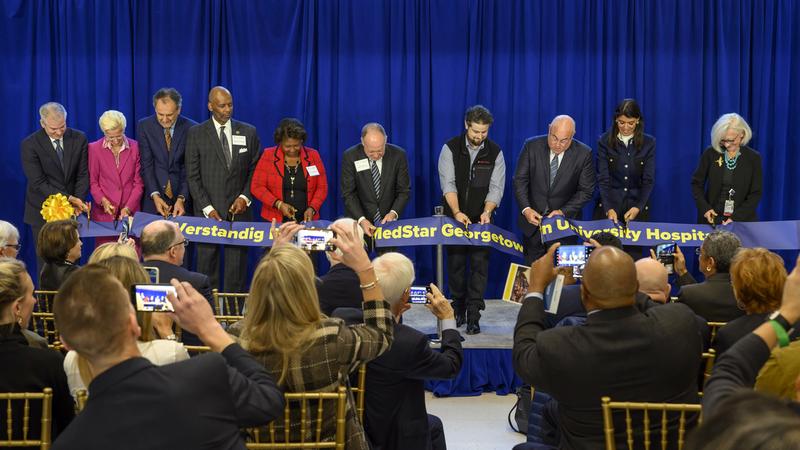
It’s what enabled him to establish the Verstandig Family Foundation, which has donated or pledged $80 million to a dozen organizations since 2017. Its largest gift was $50 million in 2021 to MedStar Georgetown University Hospital — where Verstandig had become an OR regular — to help fund the $750 million Verstandig Pavilion on Reservoir Road NW.
Verstandig hoped the dollars would not just give the hospital much-needed capacity, but set a model for more local philanthropy. Leonsis says he was among those to follow, donating $5 million — slightly less, he laughs — to the pavilion a few years later.
“For me to be able to set a mark, and be able to say, ‘This is the tide that we want to lift up’ — that’s one of the few things I’m really proud of,” Verstandig says. “Because that means my donation had a force multiplier effect.”
‘Our work will never be done’
Verstandig starts his day around 7 a.m. His head hits the pillow about 20 hours later.
He first knocks out emails and helps get his kids, ages 2 and 4, out the door. He reads a handful of news outlets, though not quite cover to cover like he used to.
He makes some calls, goes to the gym and does physical therapy, before diving into work. If it’s a Monday, he’s all in on Red Cell. If it’s another weekday, he puts on a hat for one of his other companies.
Either way, he’s out of Red Cell’s office by 5:30 p.m. to spend a couple hours with his kids, unreachable during that time. Then he eats dinner and watches a show with his wife. When she goes to bed, “that’s my time to work,” he says, thanks to chronic insomnia. He goes to sleep around 3 a.m., his mind still churning with new ideas for Red Cell.
Autism is one area that warrants more investment and attention, says Verstandig, who himself is on the spectrum. “Because we’re, as institutions, doing less, I think that’s a role for people like me and Red Cell to do more,” he says.
Most importantly, he says, “everything I do is about being a good dad” and a pervasive worry “that the world that my parents gave me might be better than the world I give my kids.”
“If you don’t have your health, what’s the point? And if you don’t have your national security and your agency, what’s the point?” he says. “Because of that, I think that our work will never be done.”
Other Posts
View All